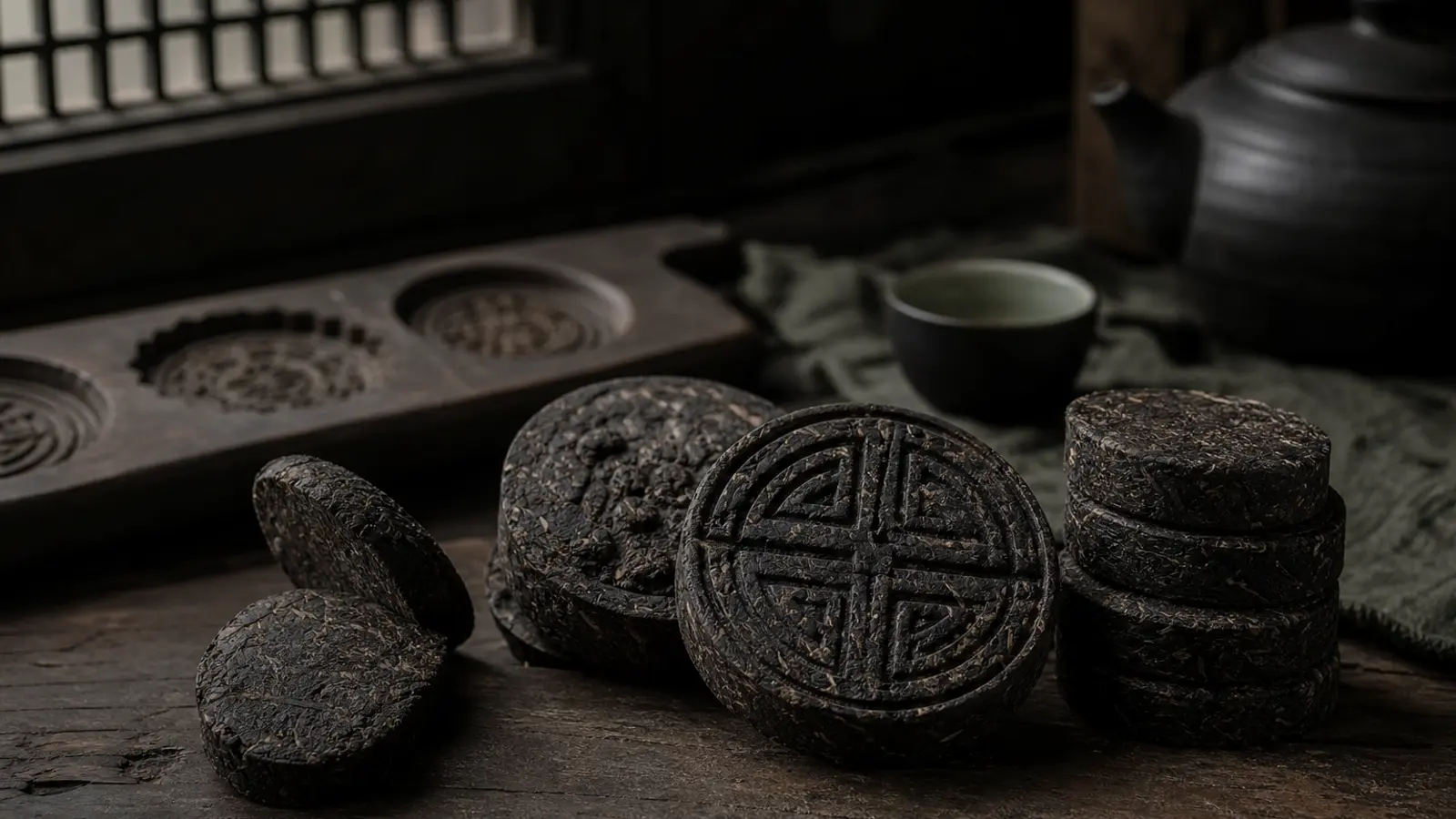
There is a category of tteok-cha (떡차, 餅茶) — Korean pressed tea — that most English-language tea resources simply don’t cover. Not because it lacks depth, but because the tradition nearly vanished. Tteok-cha is tea leaves steamed, pounded into paste, pressed into molds, and dried into solid cakes or coins. It is Korea’s oldest surviving tea format, predating and running parallel to Chinese pu-erh (普洱) cake production. And it is one of the most compelling bridges between Korean tea culture and the aging-tea world that pu-erh drinkers already know.
The name itself tells you everything. Tteok (떡) means Korean rice cake — those dense, chewy, pounded-starch blocks central to Korean cuisine. The finished tea cakes share that exact visual and textual quality: compact, smooth-surfaced, substantial in the hand. This is not loose-leaf tea pressed into a shape. It is tea transformed at a cellular level by steaming and pounding, then locked into form.
If you come from wine, the parallel I keep returning to is pétillant naturel — pét-nat. An ancient production method, nearly extinct for decades, now being rediscovered by a generation interested in pre-industrial craft. Both tteok-cha and pét-nat represent a return to origins. Both reward patience and curiosity over brand recognition.
History of Tteok-cha: From Goryeo Tribute to Near Extinction
Tteok-cha production in Korea dates to the Goryeo Dynasty (고려, 918–1392), when compressed tea was the standard format for trade and tribute. This wasn’t a regional curiosity — it was how tea moved through the Korean peninsula. Compressed cakes were easier to transport, easier to tax, and easier to standardize than loose leaf. Court records and historical texts document tteok-cha as a prestige item, offered as tribute to the throne and traded with Chinese and Japanese counterparts.
The production method was maintained most tenaciously in Buddhist monasteries (사찰, sachal), where tea practice and Buddhist contemplation have been intertwined for over a millennium. Monks preserved the steaming-and-pounding technique through centuries of cultural upheaval — the transition from Goryeo to Joseon Dynasty (조선, 1392–1897), the suppression of Buddhism under Neo-Confucian state ideology, and the catastrophic disruptions of the Japanese colonial period (1910–1945).
That colonial period nearly killed tteok-cha entirely. Japanese authorities restructured Korean agriculture around Japanese tea cultivars and production methods, favoring steamed loose-leaf green tea (sencha-style) over indigenous compressed formats. Korean tea traditions were marginalized. Much knowledge was lost.
What survived did so in monasteries and in the hands of a few families in traditional tea-growing regions — most notably Hadong (하동) in South Gyeongsang Province, where wild and semi-wild tea bushes have grown along the Seomjin River (섬진강) valley for centuries. The revival of tteok-cha is a late twentieth and early twenty-first century phenomenon, driven by artisan producers reconnecting with historical methods. It is still unfolding.
How Tteok-cha Is Made: Korean Compressed Tea Production
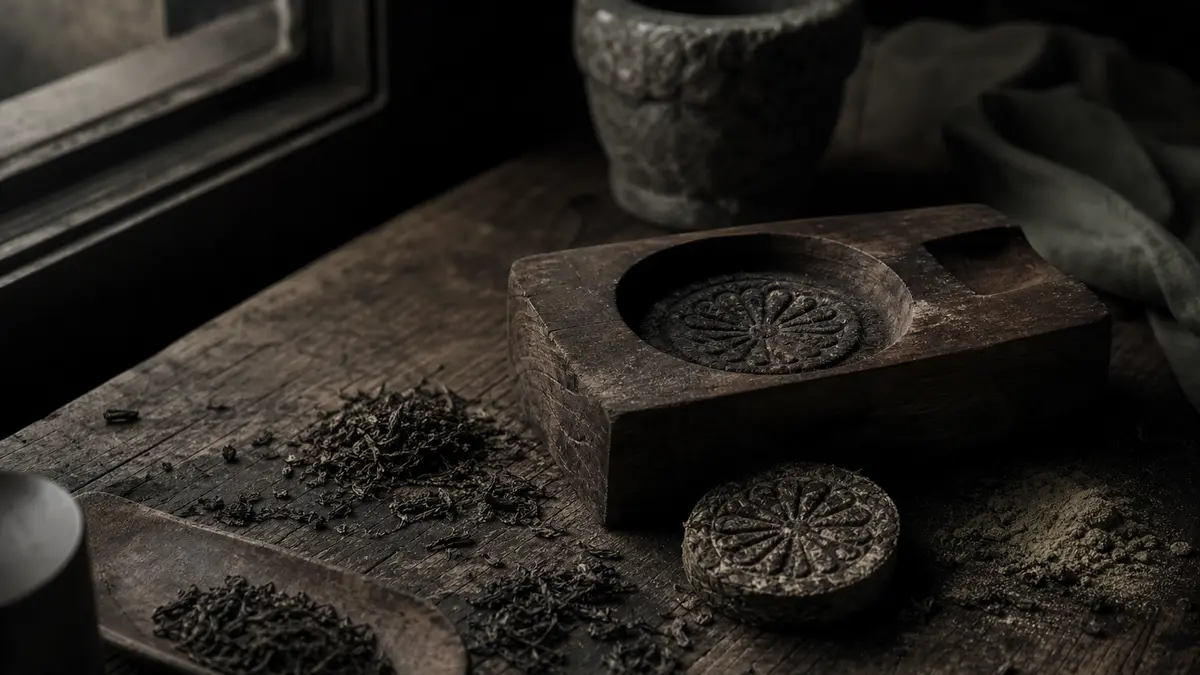
The production of tteok-cha follows a sequence that is straightforward in concept but demanding in execution. Each step matters.
1. Harvesting
Fresh tea leaves are picked, typically in spring. The standard is similar to other quality Korean green teas — a bud and two to three young leaves. Some producers use more mature leaves for cakes intended for long aging, a choice that parallels how some pu-erh producers select huangpian (黄片, older leaves) for specific aging profiles.
2. Steaming (蒸靑, jeungcheong)
The leaves are steamed, not pan-fired. This is a critical distinction. Pan-firing (as in most Chinese green teas and standard Korean nokcha / 녹차) uses dry heat to halt oxidation, producing a different cell-structure breakdown. Steaming uses wet heat, which denatures the oxidative enzymes more gently and preserves a different set of aromatic compounds. The result is a leaf that is pliable, bright green, and ready for physical transformation.
This steaming step aligns tteok-cha with Japanese processing philosophy more than Chinese. But what comes next diverges from both traditions entirely.
3. Pounding (절구, jeolgu — stone mortar)
The steamed leaves are transferred to a stone mortar (절구, jeolgu) and pounded with a heavy wooden pestle until they break down into a cohesive paste. This is not a light bruising — it is thorough mechanical destruction of cell walls. The leaves lose their individual structure and become a dense, green, sticky mass.
This pounding step is what makes tteok-cha fundamentally different from Chinese compressed teas. In pu-erh production, loose maocha (毛茶) is steamed briefly to make it pliable, then pressed into cake form — but the individual leaves remain largely intact. You can pry apart a pu-erh cake and see whole leaves. In tteok-cha, there are no individual leaves to see. The material has become something else entirely.
Think of the difference between a whole-grain bread and a pounded mochi rice cake. Same starting ingredient, completely different structural outcome.
4. Pressing and Molding
The paste is pressed into wooden or ceramic molds. Traditional shapes include:
- Coins (동전형, dongjeonhyeong) — small, flat discs
- Circles (원형, wonhyeong) — larger round cakes
- Decorative flowers — ornamental shapes for gifts and ceremonial use
The molds are often carved with patterns — chrysanthemums, characters, geometric designs. These aren’t purely decorative. The surface texture created by the mold affects drying rate and airflow, which in turn influences the final character of the tea.
5. Drying
The pressed cakes are removed from the molds and dried slowly — over days or weeks, depending on the producer, the ambient humidity, and the intended final product. This is where things get interesting.
Some producers dry their tteok-cha quickly and completely, producing a stable, shelf-ready product closer in character to a green tea in compressed form. Others allow a period of secondary fermentation during the drying phase, taking advantage of residual moisture and the broken cell structure to permit microbial activity. This secondary fermentation gives the tea an aged, complex character even when relatively young — something reminiscent of, but distinct from, young sheng pu-erh (生普洱).
The degree of fermentation during drying is one of the least documented variables in tteok-cha production. Different producers make different choices, and the results vary significantly. This is craft territory, not industrial standardization.
Tteok-cha Flavor Profile: What Korean Pressed Tea Tastes Like
Tteok-cha brews a fundamentally different cup than loose-leaf Korean green tea (녹차, nokcha). The combination of steaming and thorough pounding breaks the leaf cell structure in a way that pan-firing cannot replicate. The result is a thicker, sweeter liquor with noticeably less astringency.
Fresh Tteok-cha
A recently produced tteok-cha — within a year or two of pressing — typically offers:
- Sweet, herbaceous top notes, sometimes grassy but without the sharp vegetal edge of a Japanese sencha
- A thick, almost chewy mouthfeel — the dissolved solids from the pounded cell walls give the liquor a viscosity that loose-leaf tea rarely achieves
- A pleasant huigan (回甘) — returning sweetness in the throat — that builds across steepings
- A clean, slightly starchy finish that echoes the rice-cake reference in the name
The overall impression is gentler and rounder than most East Asian green teas. If Korean nokcha is a crisp Sancerre, fresh tteok-cha is a richer Chenin Blanc from the Loire — more body, more texture, less cutting acidity.
Aged Tteok-cha
Aged tteok-cha (5–10+ years) transforms in ways that will feel familiar to pu-erh drinkers. The warm, earthy notes emerge: dried wood, leather, autumn leaves, and a deep sweetness that has nothing to do with sugar. The liquor darkens from pale green-gold to amber or light brown.
The parallel to shou pu-erh (熟普洱) is there, but the character is distinct. Aged tteok-cha tends to retain a clean, mineral backbone that shou pu-erh sometimes buries under its heavier fermentation character. The steamed-and-pounded starting material ages differently than sun-dried maocha. Different microbes, different substrates, different results.
I want to be clear about my knowledge boundaries here: I have tasted aged tteok-cha, but the number of aged examples available to any single taster is small. The aging tradition for Korean compressed tea is far less documented than Chinese pu-erh storage science. There are no large-scale aging warehouses, no decades of temperature and humidity logs, no equivalent of the dry-storage versus wet-storage debate. This is genuine frontier territory.
Tteok-cha and Pu-erh: The Convergent Parallel
For pu-erh drinkers exploring Korean tea, tteok-cha is the natural bridge. The structural parallels are striking:
| Feature | Tteok-cha (떡차) | Sheng Pu-erh (生普洱) |
|---|---|---|
| Leaf processing | Steamed, then pounded into paste | Sun-dried (shaqing / 殺青), left as loose maocha |
| Compression | Paste pressed into molds | Loose leaves steamed briefly, pressed into cake form |
| Leaf structure in cake | Fully broken down; no individual leaves visible | Individual leaves largely intact |
| Kill-green method | Wet heat (steam) | Dry heat (wok-firing) |
| Aging potential | Yes — microbial transformation over years | Yes — microbial transformation over years/decades |
| Aging documentation | Minimal; frontier territory | Extensive; mature market |
| Flavor trajectory with age | Herbaceous → earthy, sweet, mineral | Bitter/astringent → smooth, complex, deep |
The convergent principle is clear: compress tea, retain moisture, and time plus microbes will transform it. But the production pathways are different enough that the results are not interchangeable. Tteok-cha is not “Korean pu-erh.” It is its own category with its own history and its own flavor logic.
How to Brew Tteok-cha
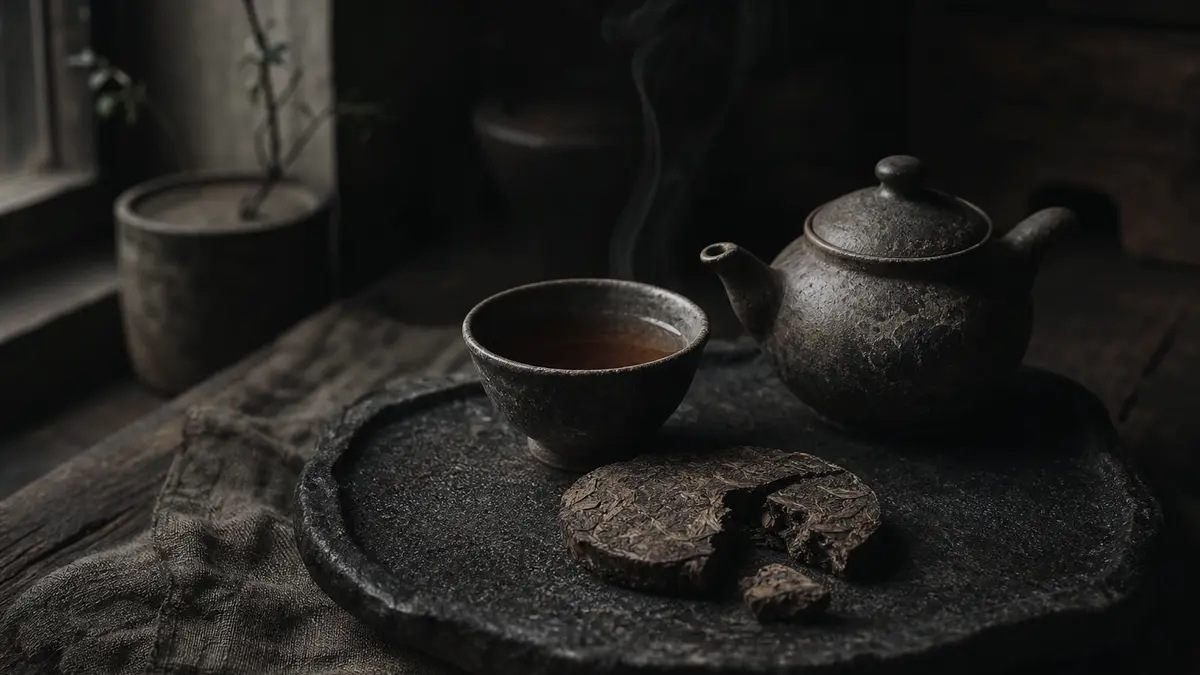
Brewing tteok-cha requires a small adjustment to standard gongfu (功夫) or Korean darye (다례, tea ceremony) parameters, because you’re working with a compressed, paste-origin material rather than whole leaves.
Breaking the Cake
Use a tea pick or a blunt knife to break off a portion from the cake. Tteok-cha is dense — denser than most pu-erh cakes — so work from the edges. You’re aiming for roughly 4–5 g per 100 ml of water.
Brewing Parameters for Fresh Tteok-cha
- Water temperature: 90–95°C
- Vessel: Gaiwan (蓋碗) or a small Korean teapot (다관, dagwan)
- Rinse: One brief rinse, 5 seconds — this opens the compressed material
- First infusion: 20–30 seconds
- Subsequent infusions: Add 5–10 seconds per round
- Expected steepings: 5–8, depending on age and compression density
Brewing Parameters for Aged Tteok-cha
Aged tteok-cha benefits from higher temperatures and, in some cases, a different method entirely. Some Korean tea practitioners simmer aged tteok-cha in a small pot (the traditional dagwan method) rather than steeping it gongfu-style. Place 4–5 g of broken cake into a pot of water at a gentle simmer — not a rolling boil — for 2–3 minutes. This method coaxes out the deeper, warmer notes that brief steeping can miss.
If you use gongfu method for aged tteok-cha, push the water temperature to a full boil (100°C) and extend steep times. The aged material can handle it.
Where Tteok-cha Comes From: Hadong and Beyond
The heart of tteok-cha production is Hadong (하동), in the Jirisan (지리산) mountain area of South Gyeongsang Province. This is Korea’s oldest documented tea-growing region, where wild tea bushes — descendants of seeds reportedly brought from Tang Dynasty China over a thousand years ago — still grow along the Seomjin River valley.
Hadong’s terroir matters. The combination of mountain elevation, river-valley humidity, and ancient semi-wild tea bush genetics produces leaf material with the depth and complexity needed to sustain the pounding and pressing process. Thin, delicate leaves from a flat, irrigated plantation would not yield the same result.
Some producers in Boseong (보성) — Korea’s largest tea-growing region, in South Jeolla Province — also make tteok-cha, though Boseong is better known for its plantation-grown nokcha. A handful of Buddhist monasteries continue the tradition as well, producing small quantities for temple use and limited sale.
Pricing and Availability
Tteok-cha is a niche product even within Korea. Production volumes are tiny — most artisan producers measure their annual output in kilograms, not tons. Expect to pay $30–80 per 100 g for quality artisan tteok-cha. Aged examples, when they surface, command higher prices, though there is no established aged-tteok-cha market comparable to the aged-pu-erh ecosystem.
Specialty Korean tea retailers and artisan producers selling direct are the primary channels. The international market is essentially nonexistent as of this writing. This will likely change as interest in Korean tea culture grows, but for now, sourcing tteok-cha requires deliberate effort.
Why Tteok-cha Matters Now
The revival of tteok-cha is part of a broader reclamation of Korean tea identity — a movement away from the Japanese-influenced green tea model that dominated the twentieth century and back toward indigenous traditions. For the international tea community, it offers something genuinely rare: a compressed, age-worthy tea format with deep historical roots but almost no English-language documentation.
For pu-erh collectors, tteok-cha is a lateral expansion — a way to explore the aging-tea concept through a different cultural and botanical lens. For Korean tea enthusiasts, it is a direct connection to a tradition that predates the current market by centuries.
And for anyone who believes that tea is best understood not as a commodity but as a cultural artifact shaped by specific hands in specific places over specific centuries — tteok-cha is exactly the kind of category worth learning about before the market discovers it and the prices follow.