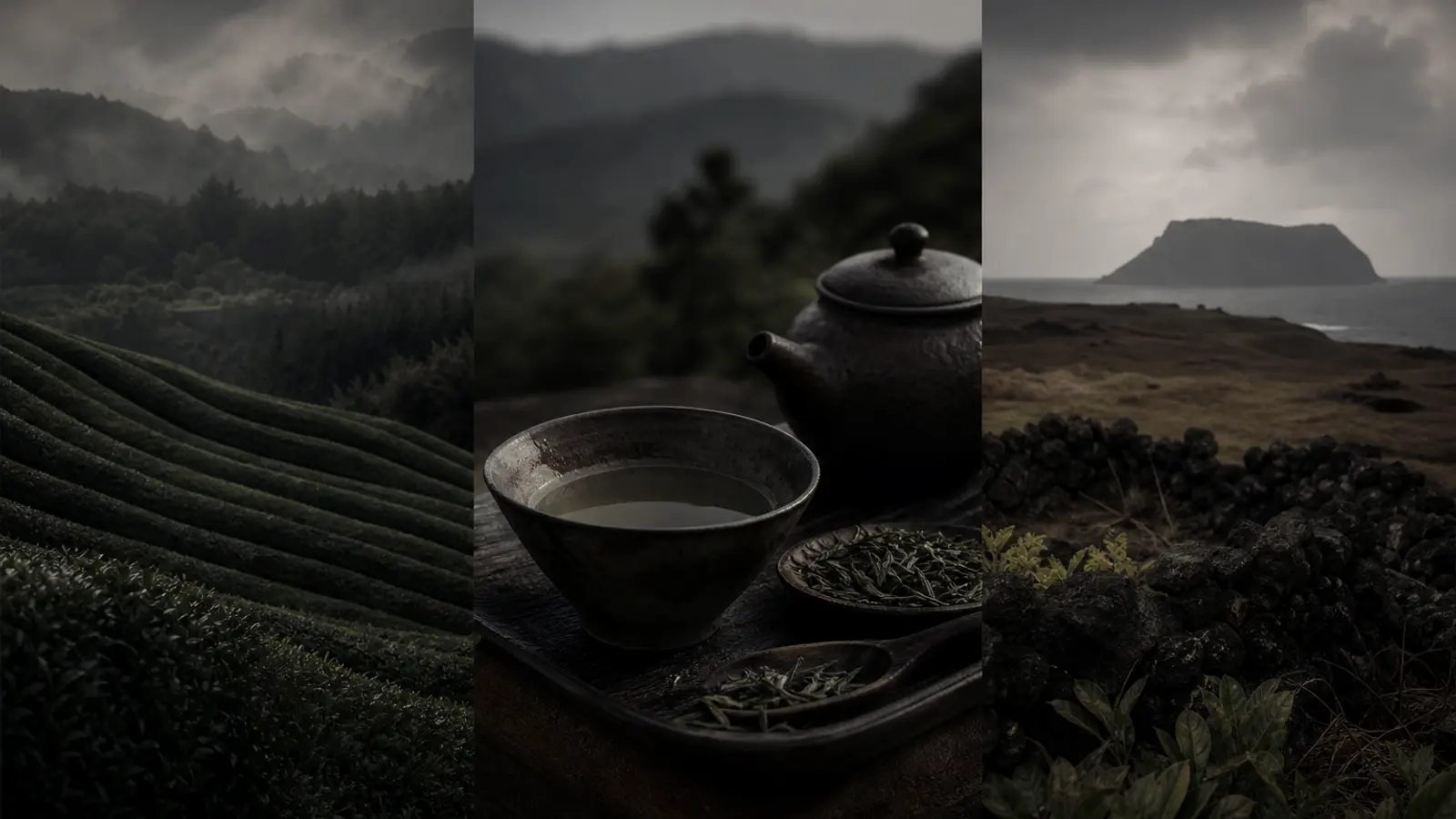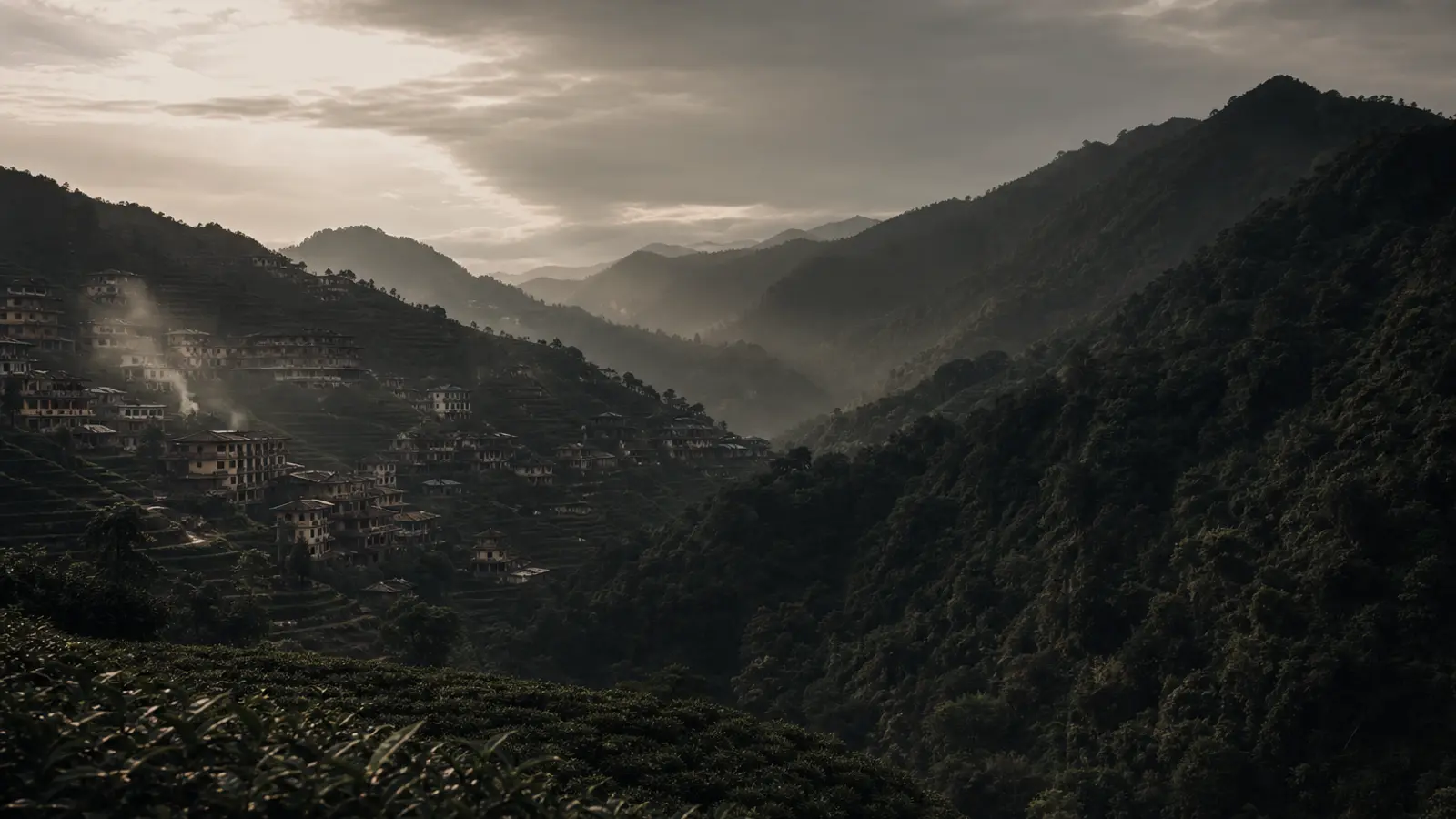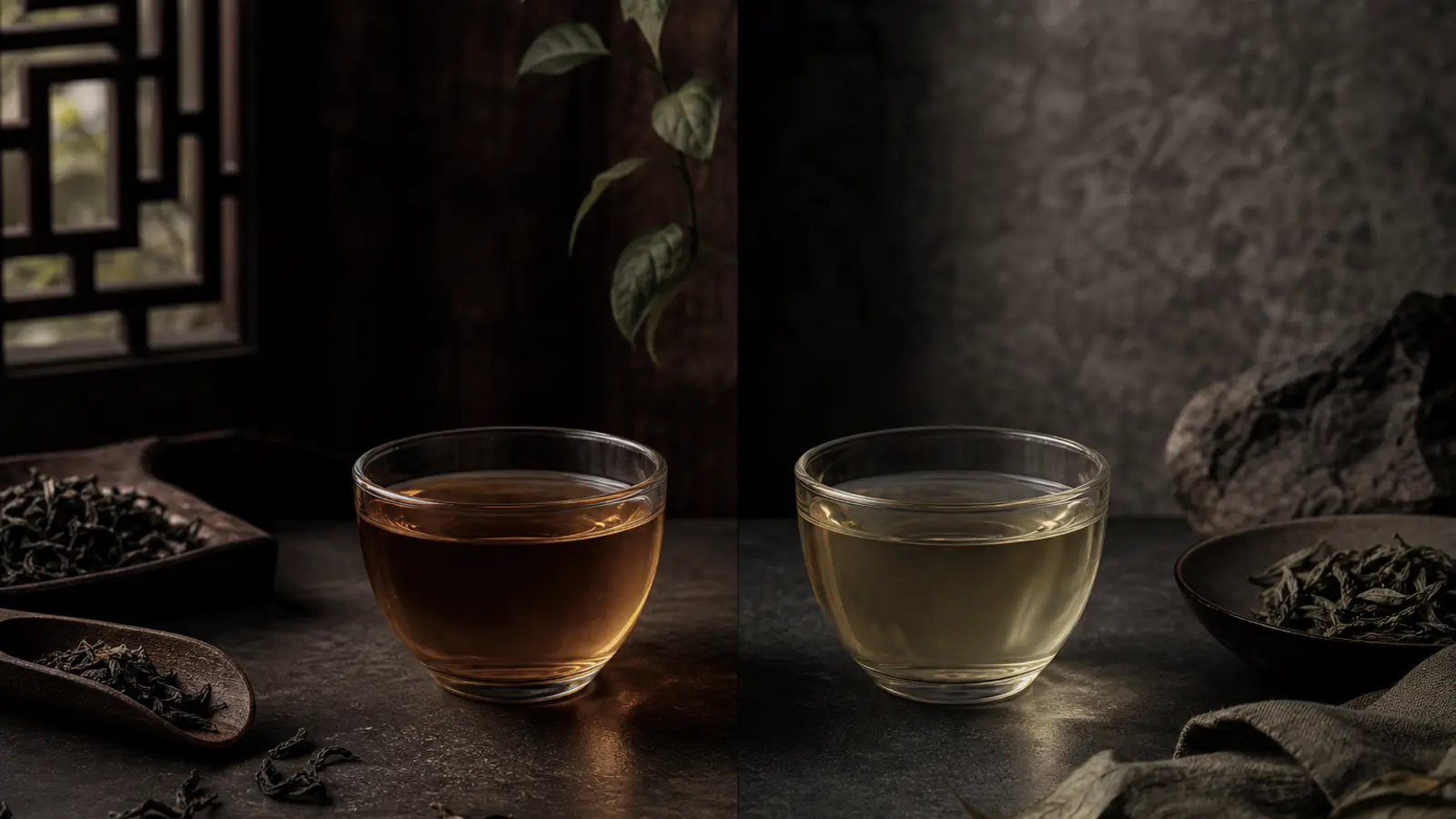
Tea terroir is the complete set of environmental factors — soil composition, elevation, rainfall, temperature, humidity, and surrounding vegetation — that shape how a tea tastes before any human processing begins. Borrowed from wine, the concept explains why the same cultivar grown on different mountains produces fundamentally different tea.
The same tea plant, grown on two different mountains fifty kilometers apart, produces tea that tastes fundamentally different. Not subtly different. Fundamentally. One is elegant and honeyed. The other is aggressively bitter with a sweetness that explodes in the throat minutes after swallowing. Same species. Same processing. Same year. Different mountain. Different cup.
That is terroir. The French wine word that means, roughly, the taste of place — the total expression of soil, climate, elevation, and human tradition that makes a Gevrey-Chambertin taste different from a Volnay even though both are Pinot Noir from vineyards eight kilometers apart.
Tea has terroir as strong as wine’s. Arguably stronger. A pu-erh from Yiwu and a pu-erh from Laobanzhang — both from Camellia sinensis var. assamica trees, both processed as sheng, both pressed into cakes — are as different in the cup as a Margaux and a Pauillac are in the glass. The mountain wrote both teas. The processing just delivered the message.
If you came to tea from wine, terroir is the concept that makes the entire landscape make sense. If you came to tea without wine, terroir is the concept that transforms tea from “a beverage” into “a map of places.”
The Five Variables
Terroir in tea operates through five variables. Each affects the leaf’s biochemistry, which is what you taste in the cup.
1. Elevation
The single most cited terroir variable in tea. Higher elevation means cooler temperatures, greater UV exposure, wider diurnal temperature swings (hot days, cold nights), and slower leaf growth. Slower growth allows the leaf to accumulate more amino acids (particularly L-theanine, which produces sweetness and umami) and aromatic compounds before it’s harvested.
The effect is measurable. Tea from 1,800 meters typically has higher L-theanine concentration, more complex aromatics, and less aggressive bitterness than tea from the same cultivar at 800 meters. This is why Taiwanese high-mountain oolong from Li Shan (2,000m+) commands prices multiples higher than lowland oolong from the same island — the elevation stress produces concentration that flat fields cannot.
But elevation is not absolute. Xigui (昔归) in Lincang produces some of Yunnan’s most prized sheng pu-erh at only 900 meters — dramatically lower than the 1,400-1,800 meter range of most premium pu-erh regions. The character comes from different stress factors: heat, a unique soil mineral profile, and a water table proximity that the highland mountains don’t share. Elevation matters, but it’s one variable among five. The tea world’s tendency to treat altitude as a universal quality shorthand (“higher is better”) is reductive. Good terroir is the interaction of all five variables, not the dominance of one.
Wine parallel: altitude in tea is like aspect and drainage in wine. A south-facing slope in Burgundy isn’t better because it’s south-facing — it’s better because the sun exposure ripens Pinot Noir in a cool climate where ripeness is the limiting factor. Change the climate (say, to Australia) and south-facing might be too hot. The variable’s importance depends on its interaction with everything else.
2. Soil
What’s in the ground shows up in the cup. Tea roots — particularly the deep taproots of old trees that penetrate three to five meters into subsoil — access mineral layers that directly contribute to the leaf’s biochemistry.
The most dramatic soil-to-cup expression in all of tea is Wuyi yan cha (岩茶, rock tea). The Wuyi Mountains are a Danxia landform — ancient volcanic rock (rhyolite, sandstone, tuff) weathered into dramatic cliffs and gorges. Tea roots penetrate cracks in this rock, accessing minerals that create the yan yun (岩韵, rock rhyme) — a stony, wet-rock mineral character that defines the category. I drink Wuyi Da Hong Pao regularly, and the mineral dimension is the highest mineral expression of any tea I’ve evaluated. That mineral is not a flavor note the processing creates. It’s the mountain, deposited in the leaf through the root system, expressed through the cup. The processing reveals it. The rock put it there.
Other soil signatures: Jeju Island’s (제주) volcanic basalt decomposition creates a mineral quality in Korean green tea unavailable from the mainland’s granitic soils. Yunnan’s deep red laterite — iron-rich, acidic — produces the characteristic body and depth of pu-erh that other provinces’ soils don’t replicate. Jingmai’s ancient tea forests grow in soil enriched by centuries of organic matter from the diverse forest canopy overhead — the mulch layer is thicker there than in any managed garden, and the tea’s pronounced floral character may partly derive from compounds deposited by the surrounding vegetation.
Wine parallel: soil in tea works like soil in wine. The slate of the Mosel gives Riesling its flinty mineral character. The limestone of Burgundy gives Pinot Noir its tension. The volcanic rock of Etna gives Nerello Mascalese its smoky edge. In each case, the geology speaks through the plant into the glass. Same principle, different beverage.
3. Climate
Temperature range, rainfall patterns, humidity, and seasonal variation all affect how the tea plant grows, when it can be harvested, and what compounds accumulate in the leaf.
Temperature determines growing speed. Cool climates (highland Yunnan, Taiwan’s central mountains, Korea’s Jirisan) produce slow-growing tea with higher amino acid concentration. Warm climates (lowland Assam, tropical Southeast Asian plantations) produce fast-growing tea with higher catechin content — more bitterness, more body, less delicacy.
Rainfall and humidity affect everything from the microbial communities that colonize leaves and soil to the speed of post-harvest processing. Yunnan’s monsoonal climate, with distinct wet and dry seasons, creates the conditions for the microbial diversity that drives pu-erh aging. Fujian’s high humidity enables the charcoal-roasting tradition of yan cha — the roast drives off moisture while the ambient humidity prevents the leaves from becoming too dry during the weeks-long roasting cycle.
Fog and mist matter more than most tea guides acknowledge. Many of the world’s great tea regions are fog-shrouded — Darjeeling, Wuyi, Jingmai, Taiwan’s Ali Shan. Fog diffuses sunlight, reducing UV stress while maintaining moisture on the leaf surface. Some researchers argue that fog-diffused light favors different amino acid production pathways than direct sunlight, contributing to the aromatic complexity of misty-mountain teas.
Seasonal variation — the difference between summer and winter — determines harvest cycles. Korean and Japanese tea have distinct spring-summer-autumn harvests because the winters are cold enough to force dormancy. Tropical regions (parts of Yunnan, Southeast Asia) can produce year-round, but spring-harvested tea from these regions still commands premiums because the winter rest period concentrates compounds in the first flush.
4. Cultivar
Not all Camellia sinensis is the same. Two major varieties — var. sinensis (smaller leaves, cooler climate tolerance, used for most Chinese green tea, oolong, and all Japanese tea) and var. assamica (larger leaves, tropical adaptation, used for pu-erh, Assam black tea, and Southeast Asian tea) — diverge significantly in biochemistry. Within each variety, hundreds of cultivars with distinct flavor signatures have been selected and maintained over centuries.
Cultivar creates the raw material that processing transforms. A Wuyi Rou Gui (肉桂, Cinnamon) cultivar produces spicy aromatic intensity that the Da Hong Pao cultivar does not, even when grown in the same rock garden and processed by the same maker. A Phoenix Mountain dancong from one bush smells like gardenias while the neighboring bush — same species, same soil, same processing — smells like almonds. The cultivar wrote the aromatic code. Processing and terroir modulate the expression. But you can’t create the gardenia from the almond bush no matter what you do.
Korea’s tea cultivars are less documented than Chinese or Japanese ones, but they’re distinct. Korean native cultivars — maintained through centuries of cultivation and natural reseeding in Hadong’s wild-grown (yasaeng-cha, 야생차) populations — produce a character that imported Chinese or Japanese cultivars grown in the same Korean soil do not fully replicate. The cultivar’s genetic identity carries information about its origin, even when transplanted.
Wine parallel: cultivar in tea is varietal in wine. Pinot Noir grown in Oregon expresses differently from Pinot Noir in Burgundy — same grape, different terroir. But Oregon Pinot still tastes more like Pinot Noir than like Cabernet Sauvignon, regardless of where either is grown. The varietal sets the boundaries. The terroir writes within them.
5. Human Tradition
Terroir is not purely geological. The human hand — generations of accumulated knowledge about when to pick, how to process, how to manage the land — is as much a part of place-character as the soil.
Wuyi yan cha’s charcoal roasting tradition shapes the final cup as profoundly as the volcanic rock shapes the raw material. Korean pan-firing (deokkeum, 덖음) in iron cauldrons produces a warm grain character that no Chinese or Japanese processing creates from the same category of leaf. Japanese shade-growing (ooishita saibai, 覆い下栽培) — covering plants for weeks before harvest to boost L-theanine — is a human intervention that creates the umami intensity of gyokuro and matcha.
These traditions evolved in specific places for specific reasons. Korean pan-firing in heavy iron cauldrons may have developed partly because the Korean peninsula’s winter cold made a warming, roasted tea more culturally desirable than a delicate green. Japanese steaming preserves the vegetal brightness that suits Japan’s aesthetic preference for freshness and seasonality. Wuyi’s charcoal roasting transforms a naturally bitter, mineral raw material into something approachable while preserving the rock character underneath.
When you taste a tea, you’re tasting the place and the people. The geology and the generation. The rock and the roast. Neither alone tells the full story.
Terroir Across Steep Atlas
The Origin section profiles tea regions using this five-variable framework. Each article covers geography, elevation, soil, climate, characteristic flavor, and the human tradition that shapes production. Wine parallels run throughout because the conceptual architecture is identical.
A few examples that illustrate how dramatically terroir operates:
Yiwu (易武) vs Laobanzhang (老班章) — both in Xishuangbanna, Yunnan, both producing sheng pu-erh from var. assamica trees. Yiwu at 1,400 meters produces elegance: soft texture, honey sweetness, long throat resonance. Laobanzhang at 1,700 meters on Bulang Mountain produces power: extreme bitterness, muscular body, explosive huigan. Fifty kilometers apart. Same species. Completely different experiences. Yiwu → | Laobanzhang →
Boseong (보성) vs Hadong (하동) — both producing Korean green tea from similar cultivars. Boseong at 50-400 meters on rolling coastal hills produces clean, bright, accessible nokcha. Hadong at 200-700 meters on the rocky slopes of Jirisan produces concentrated, complex, wild-grown yasaeng-cha. The elevation difference is modest. The soil and growing conditions diverge sharply. The result in the cup is the difference between a pleasant daily tea and something that stops you mid-sip. Boseong → | Hadong →
Wuyi Mountains (武夷山) — where the terroir is so dominant it gets its own vocabulary. Yan yun (岩韵, rock rhyme). Yan gu (岩骨, rock bone). The Danxia landform volcanic rock imprints a mineral character on the tea that overrides cultivar and processing. You can taste the mountain in every steep. No other tea origin on earth produces this specific sensation. Wuyi Mountains →
Chiang Rai highlands — Southeast Asian ancient trees at 1,000-1,400 meters producing both sheng and shou pu-erh. Same species as Yunnan (the mountains are geologically continuous across the border), but warmer climate and different soil chemistry produce a gentler, sweeter, more immediately accessible character. The terroir makes the argument: same plant, different mountain range, different tea.
The Limitations
Terroir is powerful but not everything. Two caveats worth stating.
Processing can override terroir. A badly processed tea from great terroir will taste worse than a well-processed tea from average terroir. Kill-green timing, roast management, fermentation control, and drying method all have the power to amplify or destroy what the mountain provided. Terroir sets the ceiling. Processing determines how much of that ceiling you reach.
Terroir claims are often marketing. The pu-erh market is plagued by mislabeling — tea from one mountain sold under the name of a more famous (and more expensive) one. When someone sells you “Laobanzhang gushu” at $30 per 357g cake, the terroir claim is almost certainly false. Authentic Laobanzhang gushu maocha costs $50-200+ per gram at source. The name on the wrapper is not proof of origin. Trusted sourcing, verifiable provenance, and your own trained palate are the only reliable guides.
This is why systematic tasting matters. If you’ve tasted verified Yiwu sheng and verified Bulang sheng side by side, you develop an internal reference for what each terroir should express. That reference protects you from false claims more effectively than any label or certification.
Frequently Asked Questions
What is terroir in tea?
Terroir is the total influence of a tea’s growing environment on its flavor — the combined effect of soil composition, elevation, climate, cultivar, and human processing tradition. The same tea plant grown in different locations produces measurably different tea because the roots, the air, the temperature, and the hands that process it are all different. Terroir is the reason a pu-erh from Yiwu tastes nothing like a pu-erh from Laobanzhang, even though both are the same species processed the same way.
Does terroir matter for tea the way it matters for wine?
Yes — arguably more so. Wine’s terroir expression is modulated by winemaking decisions (oak, maceration, blending, fining). Tea’s terroir expression in minimally processed categories like sheng pu-erh and white tea is more direct — fewer processing interventions between the leaf and the cup means the mountain’s voice is louder. In heavily processed categories like shou pu-erh and roasted oolong, processing has more influence, but terroir still shows through — the rock rhyme of Wuyi yan cha persists through heavy charcoal roasting precisely because the mineral compounds are heat-stable.
Why does elevation matter for tea quality?
Higher elevation means cooler average temperatures, greater UV exposure, and wider day-night temperature swings. These conditions slow leaf growth, which allows the plant to accumulate more amino acids (sweetness, umami), aromatic compounds (complexity), and less catechin (bitterness) per unit of leaf. The result is more concentrated, more complex tea. But elevation is one variable among many — exceptional tea also grows at low elevation (Xigui at 900 meters) when other terroir factors compensate.
Can you taste the difference between tea from different mountains?
With moderate experience, yes. The difference between Yiwu’s elegance and Bulang’s power is not subtle — a trained taster can identify them blind. Finer distinctions (Mahei village vs Guafengzhai village within Yiwu) require more experience and verified reference samples. The Steep Atlas tasting protocol is designed partly to build this kind of palate calibration across sessions.
What is the most terroir-expressive type of tea?
Sheng pu-erh and Wuyi yan cha are the two categories where terroir speaks loudest. Sheng pu-erh’s minimal processing (sun-drying preserves the raw expression) and yan cha’s mineral-dominant geology both create conditions where the place overwhelms the process. White tea is also highly terroir-expressive due to its minimal intervention. On the other end: shou pu-erh and heavily roasted oolongs show less terroir because the processing transformation is so significant that it partially overrides the raw material’s origin character.