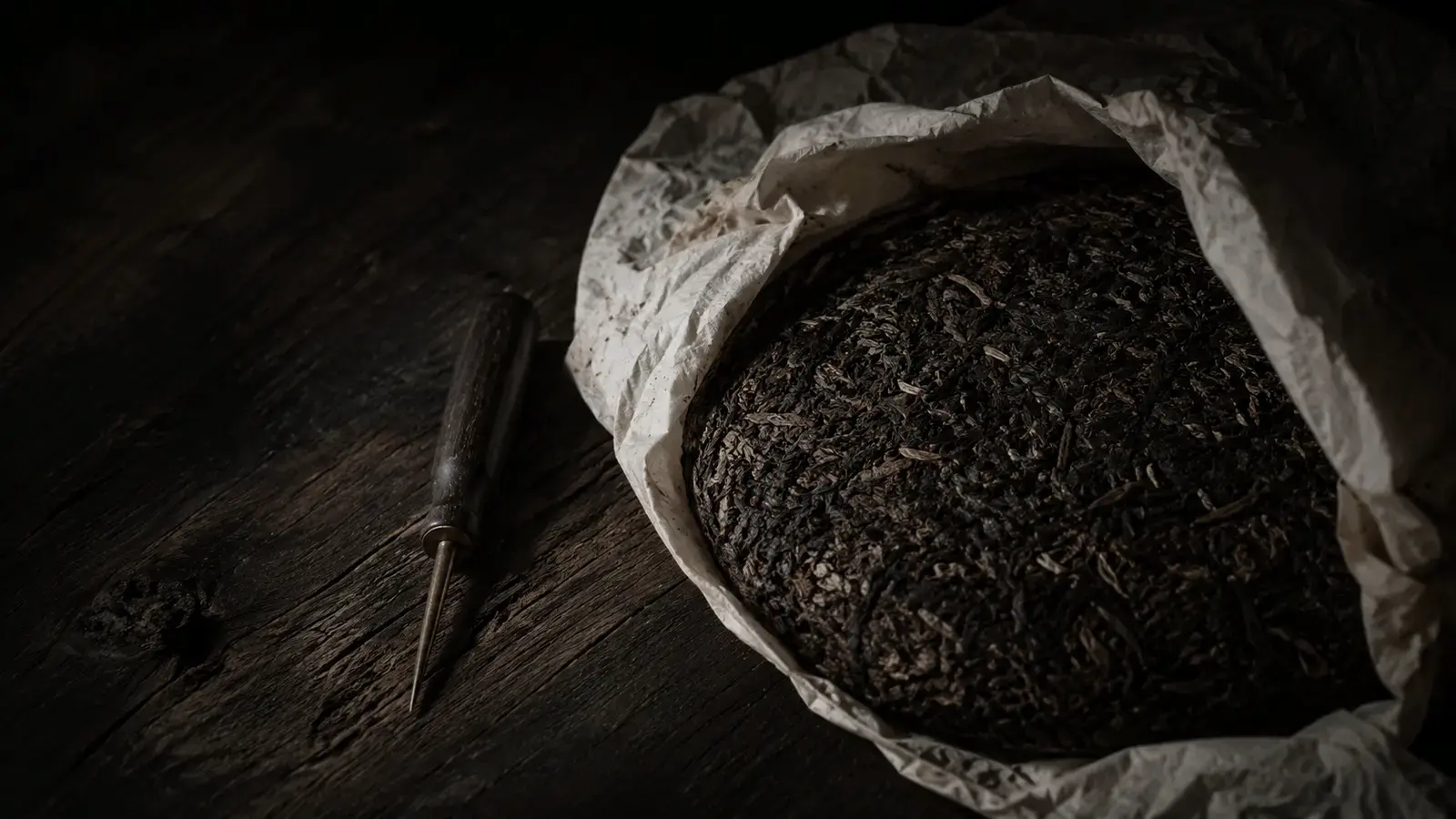
Pu-erh is tea that ages. That single fact separates it from every other tea category and explains everything else — the collectors, the warehouses, the counterfeiting, the prices that make wine look rational, and the reason someone who used to cellar Burgundy now cellars tea cakes instead.
All pu-erh comes from Camellia sinensis var. assamica, a large-leaf tea tree variety native to Yunnan province in southwestern China. The trees grow across a belt of mountains between 1,000 and 2,100 meters elevation, in subtropical forests where tea has existed for millions of years. Some of these trees are centuries old. The tea made from their leaves undergoes a processing method unique among the six tea types: after an initial kill-green step and sun-drying, pu-erh retains living microbial activity that drives slow biochemical transformation over years and decades of storage.
That living quality is what makes pu-erh age rather than simply degrade. Green tea goes stale. Black tea fades. Pu-erh evolves.
Two Categories: Sheng and Shou
Pu-erh splits into two fundamentally different teas that share a name but diverge in production, flavor, and purpose.
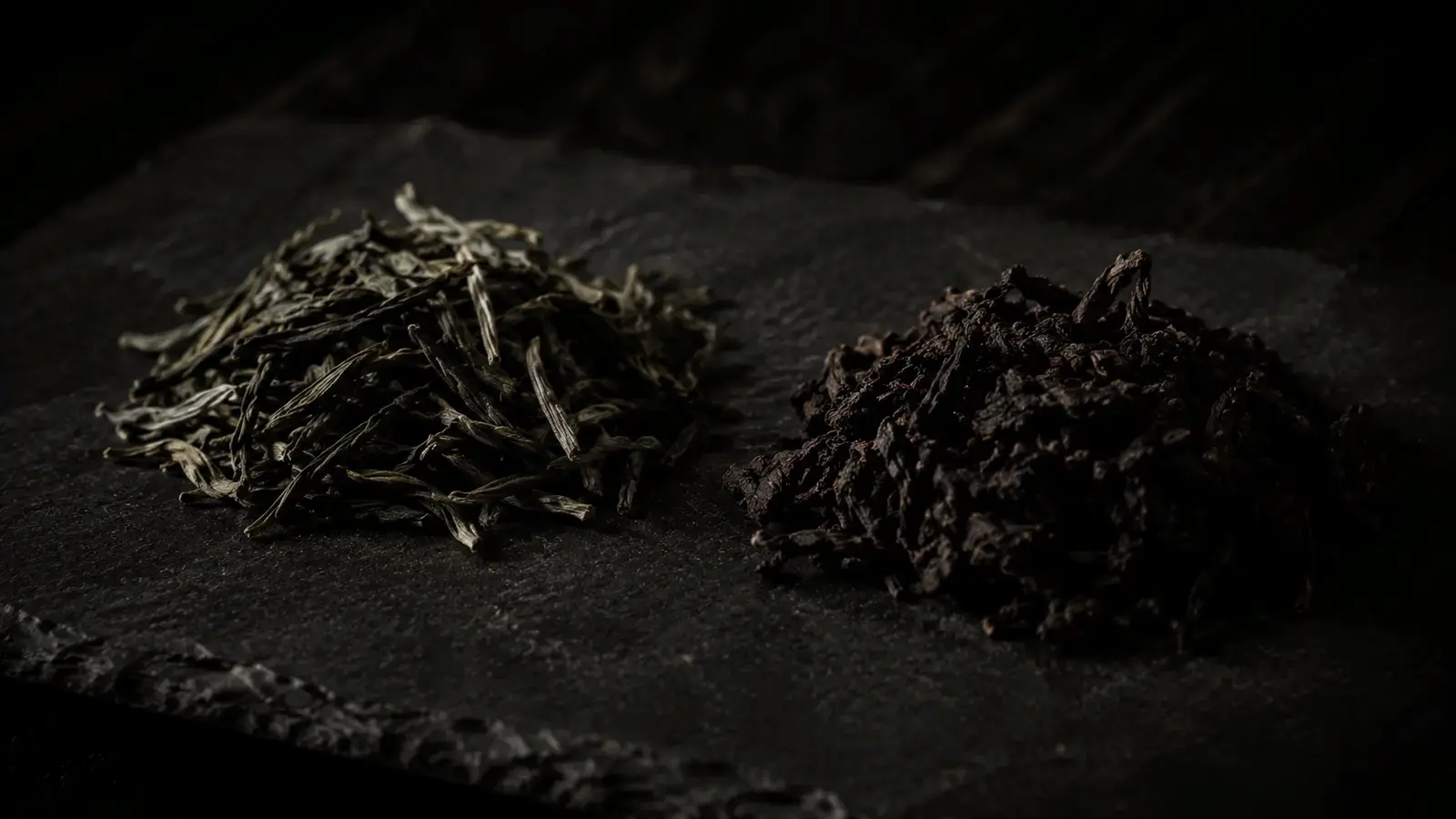
Sheng (生, raw) pu-erh is the original form. Fresh leaves are withered, pan-fired in a wok to halt oxidation (a step called sha qing, 杀青), rolled, and sun-dried. The resulting loose tea — called maocha (毛茶) — is then steamed and pressed into cakes, bricks, or other shapes. That’s it. No further processing. The tea enters the world essentially unfinished, carrying enzymatic activity and microbial potential that will drive its transformation during storage.
Young sheng is closer in character to a potent green tea than to what most people expect from “pu-erh.” It can be intensely bitter, bracingly astringent, floral, vegetal, and bright. The bitterness is not a flaw — in quality sheng, that bitterness converts rapidly to sweetness in the throat, a sensation called huigan (回甘, returning sweetness) that is the single most valued quality marker in pu-erh evaluation. The speed, intensity, and duration of huigan tells you more about the tea’s raw material than any other indicator.
Over years of storage, sheng transforms. The bitter compounds convert. The astringency softens. New aromatic compounds develop through microbial activity — camphor, dried fruit, medicinal herbs, aged wood. A 20-year sheng tastes nothing like the same tea did when it was pressed. This is the aging proposition that drives the collector market.
Shou (熟, ripe) pu-erh was developed in 1973 at Menghai Tea Factory to simulate the character of naturally aged sheng without the decades of waiting. The process, called wo dui (渥堆, wet piling), involves moistening large piles of maocha and covering them with thermal blankets. Microbial communities colonize the pile, generating heat through metabolic activity. Over 45-60 days, the accelerated fermentation transforms the tea’s chemistry — converting catechins to theabrownins, degrading chlorophyll, and creating the earthy, dark, smooth character that defines shou.
The result is immediate approachability. Where young sheng demands patience and tolerance for bitterness, shou is ready to drink upon production. The flavor profile is earthy, chocolatey, woody, and smooth. Body is thick. Astringency is minimal. Shou is the category I reach for most evenings — a session of well-made shou with its velvet mouthfeel and dark chocolate warmth is the closest thing tea offers to the comfort of a glass of aged red wine without the metabolic cost.
For a deeper comparison: Sheng vs Shou Pu-erh: The Real Differences.
Why Pu-erh Ages (and Other Tea Doesn’t)
The key is sun-drying.
Most teas are oven-dried or machine-dried at temperatures that kill the microbial communities and deactivate the enzymes in the leaf. The tea is shelf-stable but biologically dead. It can oxidize slowly, but it cannot ferment. It degrades rather than transforms.
Pu-erh’s sun-drying step preserves living biological activity. The ultraviolet exposure during outdoor drying activates specific microbial communities — primarily Aspergillus niger and related species — while keeping enzyme systems intact. When the tea is compressed into a cake and stored, these organisms continue working. Slowly. Over years and decades, successive waves of microbial communities colonize and transform the tea’s chemistry in a process that parallels ecological succession in a forest.
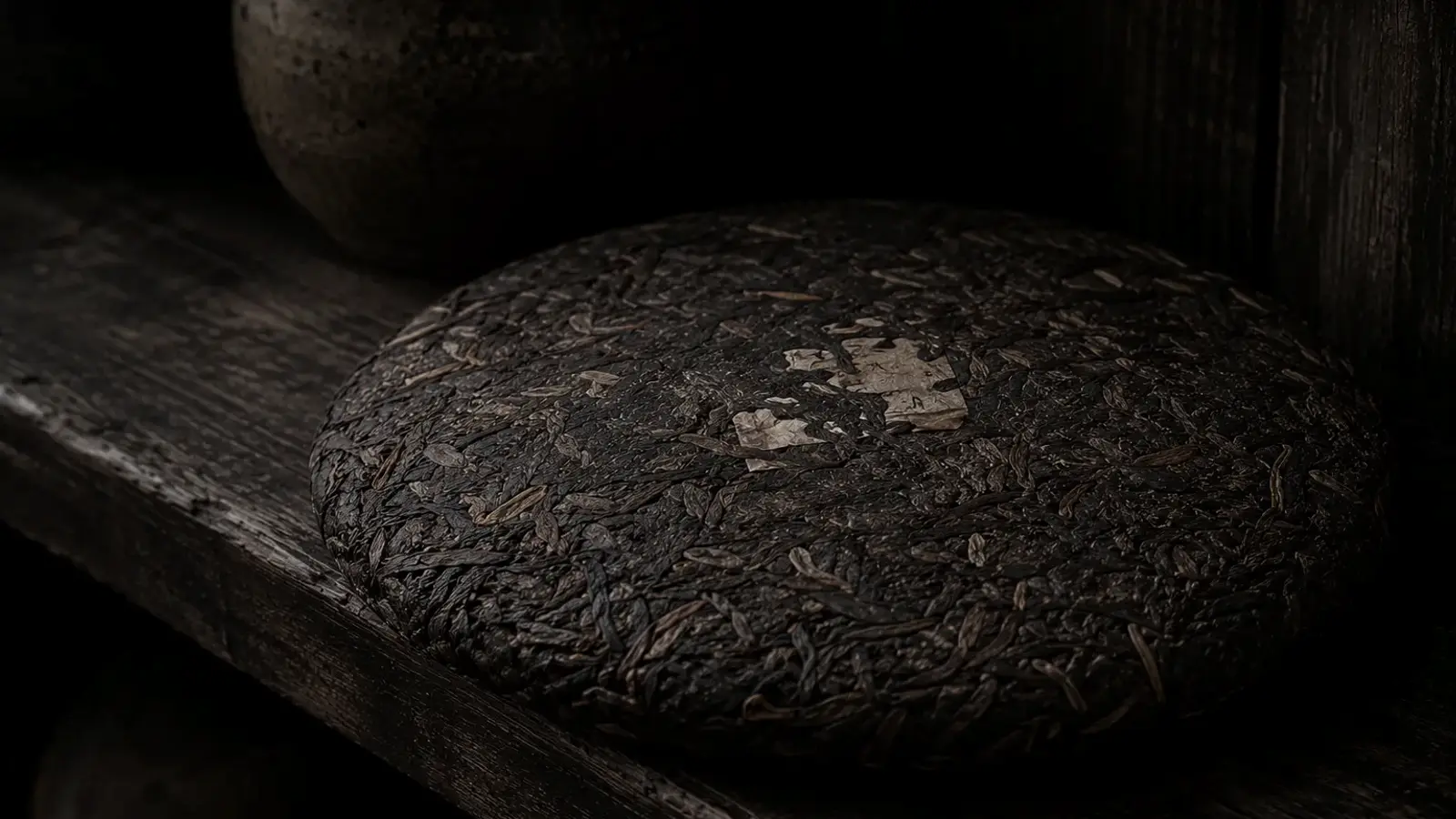
A pu-erh cake is a miniature ecosystem. The fungi that dominate in years one through five produce different metabolites than the communities that take over in years ten through twenty. This succession is what creates the complexity of well-aged pu-erh — it’s not a single transformation but a series of overlapping biological events, each leaving its chemical signature in the leaf.
Storage conditions determine which microbial pathways dominate. High humidity (75-90% RH) accelerates the process — this is traditional Hong Kong warehouse storage, where tea can develop aged character in 10-15 years. Low humidity (50-65% RH) slows everything down — Kunming’s cool, dry climate produces the most gradual transformation, sometimes requiring 25-30 years to reach comparable depth. My own storage environment in tropical Southeast Asia (70-85% RH, 28-35°C) sits between these extremes.
For the full aging timeline: How Pu-erh Tea Ages: What Happens at 5, 10, and 20 Years.
Terroir: Where the Tree Grows Changes Everything
Pu-erh is one of the most terroir-sensitive beverages on earth. The same processing applied to leaves from different mountains produces dramatically different tea — different flavor, different body, different aging trajectory, different price. If you’ve ever tasted a Burgundy next to a Barolo and understood that both are great but utterly different expressions of the grape, you’ll understand pu-erh terroir immediately.
The major pu-erh regions cluster across Yunnan’s south and west, in three main prefectures: Xishuangbanna, Pu’er (formerly Simao), and Lincang. Within each, individual mountains and villages have developed distinct reputations.
Yiwu (易武) in Xishuangbanna is the elegance region. Soft entry, silky texture, honey-like sweetness, and long throat resonance (hou yun, 喉韻). The aging trajectory of Yiwu sheng is considered the finest in all of pu-erh — gentle in youth, extraordinary in maturity. Wine parallel: Margaux. Read the Yiwu terroir profile →
Bulang Mountain (布朗山) in Xishuangbanna is the power region. Intense bitterness, thick body, muscular structure, and the most dramatic huigan conversion in pu-erh. The village of Laobanzhang (老班章) on Bulang Mountain produces the most expensive and most counterfeited pu-erh on earth — authentic gushu maocha commands $50-200+ per gram at source. Wine parallel: Pauillac. Read the Laobanzhang terroir profile →
Jingmai (景迈) in Pu’er prefecture is the aromatic region. UNESCO World Heritage ancient tea forests produce sheng with pronounced orchid fragrance and honey sweetness. Less aggressive than Bulang, less silky than Yiwu — Jingmai’s identity is floral purity. Wine parallel: Condrieu.
Lincang is the new frontier. Bingdao (冰島, “Ice Island”) produces crystal-clear sweetness with extraordinary saliva-generating quality. Xigui (昔歸) defies convention at only 900 meters elevation — proving that altitude rules have exceptions. Prices in Lincang have surged in the past decade as collectors discover that Xishuangbanna doesn’t have a monopoly on great pu-erh.
The terroir differences are not subtle. A blindfolded taster with moderate experience can distinguish Bulang’s power from Yiwu’s elegance from Jingmai’s florality. This is one of the things that makes pu-erh rewarding for anyone who came from wine — the conversation about where the leaves grew and why it matters is the same conversation, conducted in a different language.
Ancient Trees vs. Plantations
Not all pu-erh trees are equal, and the distinction between gushu (古树, ancient tree) and plantation tea (台地茶, taidi cha) drives the largest price differentials in the category.
Gushu trees are typically 100+ years old, growing in biodiverse forest environments with deep root systems penetrating three to five meters into subsoil. These roots access mineral layers that shallow plantation roots cannot reach, producing measurably different biochemical profiles in the leaf. Gushu trees are also connected to surrounding forest via mycorrhizal fungal networks — sharing nutrients and chemical signals with neighboring species. The resulting tea carries a character that Chinese tasters call shan ye qi yun (山野氣韻, mountain-wild atmosphere) — a forest energy that is absent from plantation tea grown in managed monoculture rows.
Plantation tea — planted in the 1950s-1980s during government campaigns to expand production — grows in neat rows at lower elevations. The trees are younger, the roots are shallower, and the growing environment lacks the biodiversity of old-growth forest. Plantation pu-erh tends toward simpler flavor, higher astringency, less complexity, and fewer productive steeps.
The price gap is enormous. Plantation maocha: $5-20/kg. Gushu maocha from a named village: $200-10,000+/kg. Whether the gap is justified is a question every pu-erh drinker eventually wrestles with. The honest answer: in the best examples, yes. The complexity, the steep endurance (genuine gushu produces 15-20+ steeps with maintained depth), and the aging potential are measurably different. But the label “gushu” alone guarantees nothing — processing skill matters as much as tree age, and counterfeiting of gushu claims is rampant.
How to Brew Pu-erh
Pu-erh rewards gongfu brewing — the method of using a small vessel, high leaf-to-water ratio, and multiple short infusions to extract the tea’s full range of expression across a session.
Standard parameters:
The rinse: pour boiling water over the leaves, discard immediately. This isn’t about “washing” the tea — it’s about waking the leaves, hydrating compressed material, and priming the first real steep. For aged pu-erh, I sometimes do two rinses.
Steep progression: start short (5-10 seconds for the first steep), then gradually extend as the leaves open and release their compounds more slowly. A typical session runs 10-15 steeps, with the last steeps at 60-120 seconds. The flavor arc across these steeps is the experience — it’s like tasting a wine as it opens in the glass, except you get fifteen distinct snapshots instead of one gradual evolution.
| Parameter | Sheng (Raw) | Shou (Ripe) |
|---|---|---|
| Leaf amount | 6-7g per 100ml | 7-8g per 100ml |
| Water temperature | 90-95°C (young), 95-100°C (aged) | 95-100°C |
| First steep | 8-10 seconds | 10-15 seconds |
| Steep progression | +5s per steep | +5-10s per steep |
| Expected steeps | 10-15+ | 8-12 |
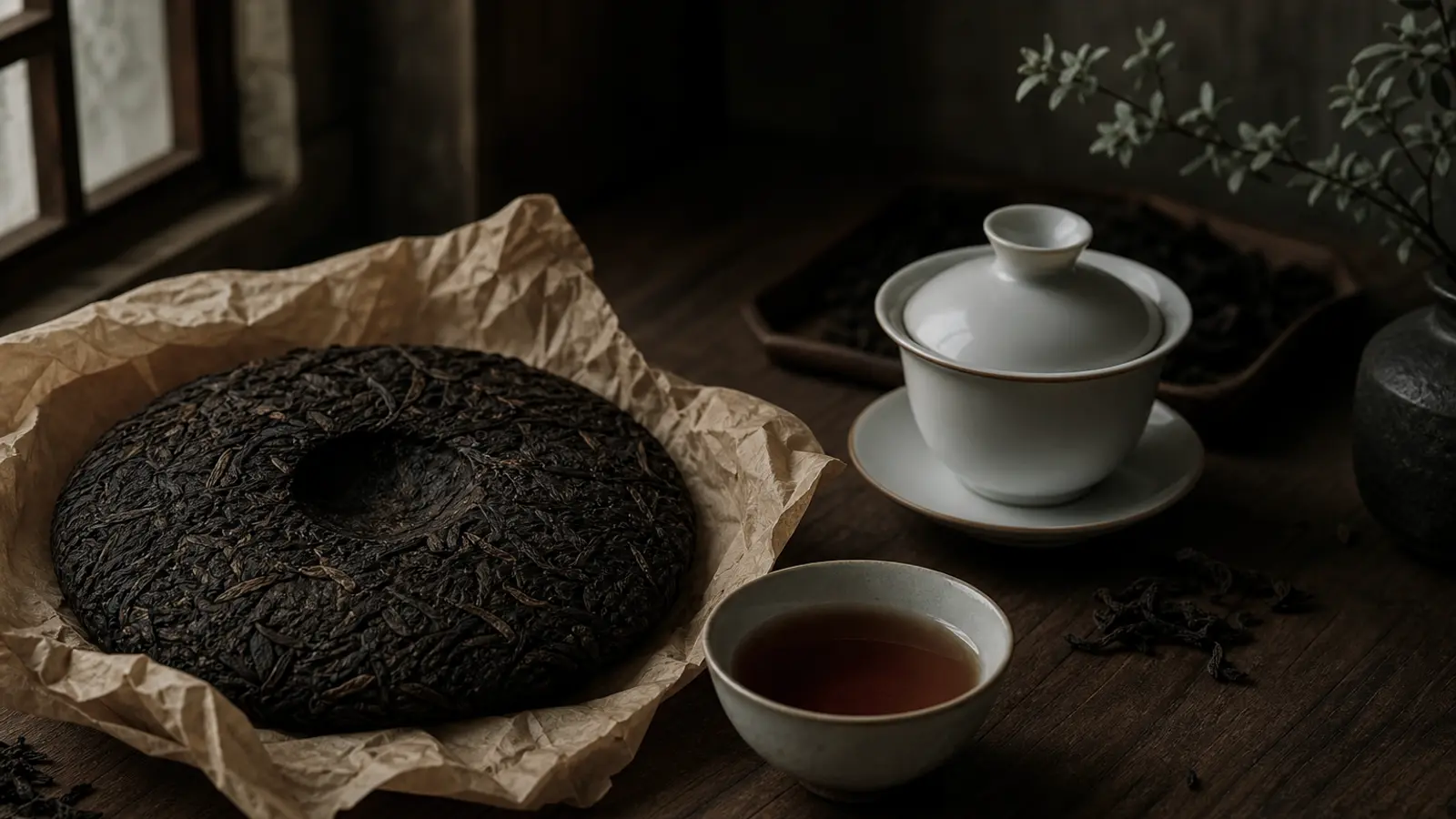
Vessel choice: A white porcelain gaiwan (盖碗) is the standard analytical tool — neutral, reveals the tea without adding anything. For daily sessions with a tea you know well, a clay teapot (Yixing, Jian Shui, or Korean celadon) adds warmth and develops seasoning over time. I use a 100ml white porcelain gaiwan for every tasting note on this site. The parameters are standardized so sessions are comparable.
Do not underdose. This is the single most common beginner mistake with pu-erh, and it took me weeks to figure out. At 4-5g per 100ml, pu-erh reads as thin and sweet without structure — the tea equivalent of watering down wine. At 7-8g per 100ml, the body, huigan, and complexity emerge. A digital scale changed my brewing more than any other equipment upgrade.
What Pu-erh Costs
The price range in pu-erh is wider than in almost any other food or beverage category.
Entry level ($0.03-0.10/g): Factory-produced shou cakes from Menghai Tea Factory (Dayi), Xiaguan, or similar. Consistent, clean, unremarkable. This is the pu-erh most people worldwide have tasted. A 357g cake costs $10-35. Good daily tea.
Mid-range ($0.15-0.50/g): Small-factory or artisan-produced shou and sheng from identified regions. Better raw material, more attention to processing. This is where pu-erh starts getting interesting. A 357g cake costs $50-180. The sweet spot for developing your palate.
Premium ($0.50-3.00/g): Single-village sheng from named mountains. Gushu material with traceable provenance. Aged shou from quality producers. A 357g cake costs $180-1,000. This is where pu-erh conversation gets serious — terroir expression, aging potential, and the collector market.
Collector ($3.00-50+/g): Aged cakes from the 1990s and earlier with verified storage provenance. Current-year gushu from celebrity villages like Laobanzhang and Bingdao. A single cake can cost $1,000-50,000+. For most drinkers, sampling these through shared sessions or small purchases is more realistic than collecting.
My own practice sits in the entry-to-mid range. A 100g package of ancient tree shou from a reputable vendor costs approximately $16.50 — about $0.165/g. A single session uses 7g. That’s $1.15 per session for 10+ steeps of complex, deeply satisfying tea from 300-500 year old trees. The cost-per-experience ratio in pu-erh is extraordinary compared to wine, coffee, or spirits.
The Wine Parallel
I came to pu-erh from wine, and the structural similarities are what made me stay.
Terroir arguments in pu-erh mirror terroir arguments in wine — which mountain, which slope, which soil, which elevation. Vintage matters — a 2005 pressing from the same village and the same producer will taste different from a 2010. Cellaring conditions shape the outcome as much as the raw material — just as a Burgundy stored at 18°C develops differently from one stored at 12°C. There is a collector market driven by scarcity, reputation, and the romance of aging. There is counterfeiting, hype, and the gap between marketing and reality.
The difference is accessibility. A bottle of Grand Cru Burgundy opens once and serves a table. A 357g pu-erh cake yields 50+ sessions over years. You can track its evolution across months and seasons of storage. You can brew it differently each time and discover new dimensions. And you can do it alone, at midnight, in silence, with no social performance required.
That last part matters to me more than the terroir.
Where I Am With Pu-erh
I came back to tea seriously in early 2026. My collection is small and deliberate — Thai-origin sheng and shou, aged material from the 1980s and 2000s, and a growing set of regional comparison samples. I’ve tasted pu-erh from trees estimated at 300-500 years old and from 20-year and 30-year aged cakes. I’ve experienced cha qi (茶气) strong enough to induce cha zui (茶醉, tea drunkenness) on an empty stomach — a 1988 aged sheng that produced a camphor-cypress aroma I described in my notes as “smelling time itself.”
I have not tasted Laobanzhang. I have not tasted Bingdao. I have not visited Yunnan. The terroir profiles on this site for those regions are research-based, clearly marked as such, and will be updated with firsthand notes when the tasting arrives.
This is not false modesty. It’s the site’s operating principle: every claim is graded by evidence type. When I’ve brewed it, you’ll know. When I haven’t, you’ll know that too. The map is accurate to what’s been explored. The blank spaces are labeled, not hidden.
Where to Go Next
If this is your first encounter with pu-erh, here’s the reading path:
Sheng vs Shou Pu-erh: The Real Differences goes deeper on the two categories with tasting descriptions and a comparison table.
How Pu-erh Tea Ages covers the transformation timeline at 5, 10, and 20 years — what changes, what improves, and when the magic happens.
Gongfu Brewing: The Complete Method is the practical manual for extracting everything pu-erh has to offer, with specific parameters for every tea type.
If you already know pu-erh and want the terroir deep-dive, start with the Origin section — Yiwu, Bulang, Laobanzhang, Jingmai, Menghai, and more, each profiled with elevation, soil, flavor signatures, and wine parallels.
The map is open. Follow what interests you.
Frequently Asked Questions
What does pu-erh tea taste like?
Pu-erh ranges widely depending on type and age. Young sheng (raw) pu-erh is bright, bitter, and floral — closer to a potent green tea. Shou (ripe) pu-erh is earthy, smooth, and dark — chocolate, wood, and wet earth. Aged sheng transforms over decades into something with camphor, dried fruit, and medicinal depth. The range within pu-erh is as wide as the range within wine.
Is pu-erh tea good for beginners?
Yes, but start with shou (ripe) pu-erh. It’s smooth, low in bitterness, and forgiving to brew — even oversteeping won’t make it harsh. Young sheng can be aggressively bitter and astringent for newcomers. Think of shou as the Merlot and young sheng as the Barolo: one is accessible, the other demands patience.
Does pu-erh tea have caffeine?
Yes. Pu-erh contains roughly 30-70mg of caffeine per cup, depending on leaf age, steep number, and brewing method. In gongfu brewing, the first two steeps carry the bulk of the caffeine. Later steeps are progressively lighter, which means you can control your intake by timing your session. Aged shou pu-erh tends to have less caffeine than young sheng.
How long can pu-erh tea age?
Properly stored pu-erh can age for decades. Some collectors drink cakes from the 1950s-1970s. The practical sweet spot for most drinkers is 10-25 years of aging, where the tea has transformed significantly but remains available at non-auction prices. Storage conditions matter more than time — a well-stored 15-year cake can surpass a poorly stored 30-year cake.
Why is pu-erh tea so expensive?
Price varies enormously. A factory-produced shou cake costs $10-30. A current-year gushu (ancient tree) cake from a famous village like Laobanzhang can cost $500-5,000+. A verified aged cake from the 1990s or earlier commands collector prices of $1,000-50,000+. The drivers are tree age, village reputation, storage provenance, and age. Most of the pu-erh market is affordable — the extreme prices get the attention.